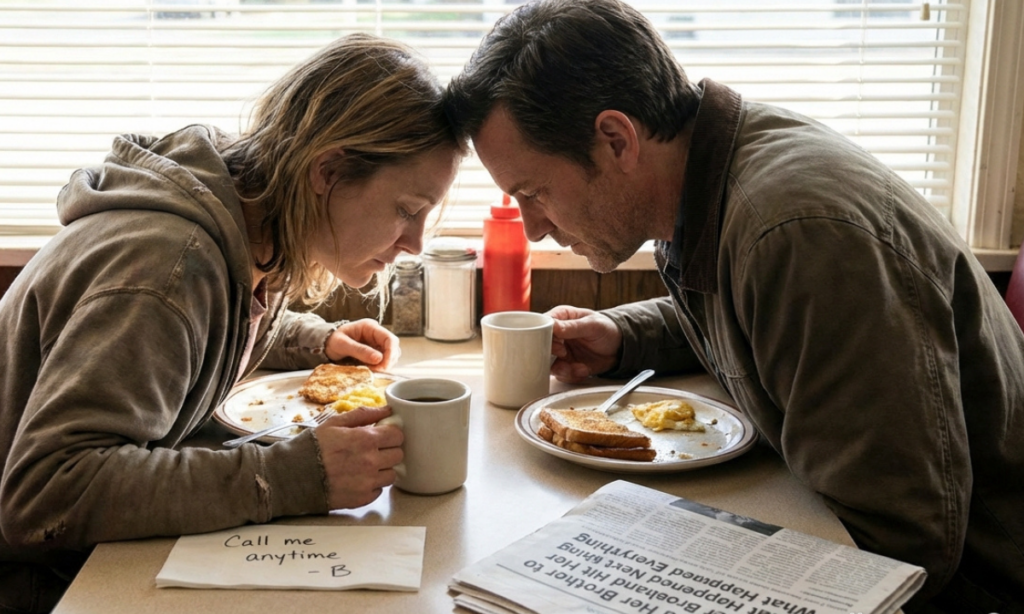
She Invited Her Brother to Breakfast After Her Husband Hit Her What Happened Next Changed Everything
A survivor’s story of courage, strategic planning, and the family intervention that broke seven years of silence
The Morning After
Emily Carter woke up at 5 AM with a plan. Her face still ached from where Daniel had struck her the night before. The argument had started over something trivial burned toast, of all things and escalated into violence that left visible marks she’d have to cover with makeup again.
But this morning would be different.
Instead of crying quietly in the bathroom or making excuses about her bruises, Emily picked up her phone and sent a text message that would change everything: “Michael, can you come for breakfast? 8 AM. Don’t tell Daniel.”
Her brother’s response came within minutes: “I’ll be there.”
Seven Years of Hidden Violence
The abuse hadn’t started on their wedding day. It never does.
Daniel had been charming during their courtship attentive, romantic, everything Emily thought she wanted in a partner. The first time he grabbed her arm too hard during an argument, he apologized profusely. Bought her flowers. Promised it would never happen again.
But it did happen again. And again. And again.
Over seven years, the violence evolved from occasional outbursts into a systematic pattern. A shove became a slap. A slap became a punch. Verbal attacks accompanied the physical ones, gradually eroding Emily’s confidence until she questioned her own worth and judgment.
Daniel was careful, too. He hit her where clothing would hide the bruises. He isolated her from friends by creating drama before social events until she stopped accepting invitations. He controlled their finances, making sure she couldn’t access money to leave. He convinced her that no one would believe her, that she was overreacting, that the abuse was somehow her fault.
The gaslighting was almost worse than the violence. After particularly brutal incidents, Daniel would deny they happened or claim Emily was being “too sensitive.” He portrayed himself as the victim of her emotional instability, a patient husband dealing with a difficult wife.
Emily’s family noticed changes her withdrawn behavior at gatherings, the weight loss, the nervous energy, the occasional bruise she explained as clumsiness. But she maintained the facade of a happy marriage, terrified of what Daniel would do if she exposed the truth.
The Brother Who Knew
Michael had suspected something was wrong for over a year. His sister had changed. The vibrant, confident woman who’d always been close to her family had become a shadow quiet, anxious, always checking her phone as if monitoring someone’s mood.
At a family barbecue six months earlier, he’d noticed fingerprint bruises on Emily’s upper arm. When he asked about them, she’d given a vague excuse about bumping into a door. But the way she’d glanced nervously at Daniel told Michael everything he needed to know.
That evening, Michael had pulled Daniel aside and delivered a warning: “If you ever hurt my sister, you’ll answer to me. And I won’t be gentle about it.”
Daniel had laughed it off, claiming Michael was overreacting to an accident. But after that conversation, Daniel made sure Emily attended fewer family events. The isolation intensified.
Michael had been waiting for Emily to reach out, ready to help the moment she asked. When her text arrived that morning, he didn’t hesitate.
The Strategic Breakfast
Emily spent the early morning hours preparing an elaborate breakfast all of Daniel’s favorite foods. Pancakes, bacon, fresh fruit, expensive coffee. She set the table with care, making everything look perfect.
To Daniel, this would look like submission. Like she’d learned her lesson from last night’s “discipline.” He expected her to be compliant, apologetic, eager to please after he’d put her in her place.
Emily was counting on that expectation.
At 7:45 AM, Michael arrived. Emily let him in quietly, and they positioned themselves at the kitchen table. Michael took a seat where Daniel would see him immediately upon entering the room.
When Daniel walked into the kitchen at 8:10, still in his pajamas, he stopped cold.
“What the hell is he doing here?”
“Sit down, Daniel,” Emily said, her voice steadier than she’d heard it in years. “We need to talk.”
The Confrontation
Daniel’s face cycled through emotions rapidly confusion, anger, fear. The presence of Michael changed everything. This wasn’t his isolated, frightened wife. This was a witness. Someone who could expose what he’d been hiding.
“Emily called me,” Michael said calmly. “She told me what you did last night. She told me what you’ve been doing for years.”
“I don’t know what she “
“Don’t.” Michael’s voice was quiet but carried unmistakable authority. “I’ve seen the bruises. I’ve watched my sister become a shell of herself. I’ve noticed how you control every aspect of her life. This ends now.”
Daniel tried his usual tactics denial, minimization, turning the blame on Emily. “She’s exaggerating. You know how emotional she gets. Last night was barely “
“Hit her face,” Emily interrupted, looking directly at her husband. “You hit my face. You left marks. And you’ve hit me dozens of times before that. You’ve choked me. Thrown things at me. Threatened to kill me if I ever left.”
The room fell silent.
“Is that true?” Michael asked Daniel, though the answer was written all over the man’s face.
Daniel said nothing.
The Ultimatum
What followed was a three-hour conversation that dismantled seven years of abuse, lies, and control.
Michael laid out what he’d observed the changes in Emily’s behavior, her social withdrawal, the visible injuries she’d tried to hide. He spoke calmly but firmly about the seriousness of domestic violence and the legal consequences Daniel faced if the abuse continued.
“Here’s what’s going to happen,” Michael said. “First, you’re going to leave this house today. You’ll stay somewhere else while Emily decides what she wants to do about this marriage.”
“This is my house “
“It’s both your names on the deed,” Michael corrected. “And if you want to argue about it, we can involve the police and discuss those bruises on Emily’s face. Your choice.”
Daniel’s face reddened, but he stayed seated.
“Second,” Michael continued, “Emily will have full access to bank accounts and credit cards. No more financial control. If I find out you’ve tried to cut her off from money, I’ll make sure everyone you work with knows exactly what kind of man you are.”
“You can’t “
“Third, if you ever touch her again, I’m not calling the police first. I’m coming for you myself. And then we’ll call the police. Understood?”
The transformation in Daniel was striking. Without his usual advantage a isolated, fearful victim he was exposed. Vulnerable. Facing real consequences for the first time.
The Power of Witnesses
Emily watched her husband shrink under her brother’s steady gaze. For years, Daniel had seemed omnipotent within the walls of their home. His anger had controlled her every move, his violence had kept her compliant, his gaslighting had made her doubt reality.
But with Michael present, she saw Daniel clearly for the first time not as an all-powerful force, but as a coward who only felt strong when hitting someone smaller and more vulnerable.
“I’m done,” Emily said quietly. The words felt both terrifying and liberating. “I’m done pretending this is normal. I’m done covering bruises and making excuses. I’m done being afraid in my own home.”
Daniel looked at her with something between shock and fury. He opened his mouth to speak probably to threaten, to manipulate, to remind her of all the ways he could make her life hell.
“Don’t,” Michael warned. “Whatever you’re about to say, don’t. Pack a bag and leave. Now.”
The Aftermath
Daniel left that morning with a suitcase and a warning. The house felt different immediately lighter, safer, like Emily could finally breathe without measuring each breath against Daniel’s mood.
Michael stayed for the rest of the day, helping Emily change the locks and setting up safety measures. He connected her with a domestic violence advocate who explained her legal options, including restraining orders and divorce proceedings. He helped her open a separate bank account Daniel couldn’t access.
Most importantly, he listened as Emily talked really talked for the first time in years. She described the escalating violence, the constant fear, the way Daniel had systematically isolated her from everyone who cared about her. She cried. She raged. She grieved for the years she’d lost to abuse.
“Why didn’t you tell me sooner?” Michael asked gently.
“Because he convinced me no one would believe me,” Emily said. “He said I was crazy, that I was making things up, that everyone would think I was the problem. And I started believing him.”
“I believe you,” Michael said firmly. “I’ve always believed you. I was just waiting for you to be ready to get help.”
Breaking the Cycle
In the weeks that followed, Emily filed for divorce and obtained a restraining order after Daniel violated Michael’s ultimatum by showing up at the house drunk and demanding to be let in. The police report documented not only that incident but also Emily’s photographs of previous injuries and her detailed account of years of abuse.
Daniel’s family tried to intervene, claiming Emily was overreacting and that every couple has problems. His mother called Emily dramatic. His father suggested marriage counseling, as if therapy could fix a man who beat his wife.
But Emily had something she hadn’t had before a support system that believed her. Michael ensured she wasn’t isolated. Other family members, once they learned the truth, rallied around her. Friends she’d lost contact with reconnected, expressing guilt that they hadn’t recognized the signs sooner.
The divorce was contentious. Daniel fought for the house, for money, for anything he could use to maintain control. But with legal representation provided by a domestic violence organization and her family’s support, Emily held firm.
A year after that strategic breakfast, Emily was free legally divorced, living in her own apartment, rebuilding relationships Daniel had destroyed, and working with a therapist to process the trauma of seven years under his control.
The Lessons Learned
Emily’s story illustrates several critical truths about domestic violence:
Abuse escalates gradually. It rarely starts with a punch. It begins with controlling behavior, verbal attacks, isolation building a foundation of fear and dependency before the physical violence intensifies.
Victims aren’t weak. Emily’s strategic planning preparing the perfect breakfast, timing the confrontation, bringing in a witness showed remarkable strength and intelligence. Staying in an abusive relationship doesn’t indicate weakness; it reflects the complex psychological manipulation and real physical danger that make leaving extremely difficult.
External intervention matters. Michael’s willingness to confront Daniel and provide ongoing support was crucial. Many victims can’t escape without help from family, friends, or professionals who can offer safety, resources, and validation.
Secrecy protects abusers. As long as the violence remained hidden, Daniel faced no consequences. The moment his behavior was exposed to someone whose opinion he cared about, his power diminished significantly.
Leaving is dangerous. The period when a victim tries to leave or has just left an abusive relationship is statistically the most dangerous time for escalated violence or homicide. Emily needed protection, legal intervention, and ongoing vigilance even after Daniel moved out.
Moving Forward
Today, Emily speaks publicly about her experience with domestic violence. She volunteers with organizations that help abuse survivors, knowing that her story might give someone else the courage to reach out for help.
“That breakfast was the first time in seven years I’d taken control of my own life,” Emily reflects. “I’d let Daniel dictate everything—where I went, who I saw, how I spent my time, even how I felt about myself. Inviting Michael without Daniel’s permission was terrifying. But it was also the first step toward reclaiming my autonomy.”
She’s also honest about the ongoing challenges. Recovering from years of abuse isn’t linear. She still flinches at loud noises. She struggles with trusting new relationships. She has nightmares about Daniel finding her, despite the restraining order and her new address that he doesn’t know.
But she’s healing. Slowly, with professional help and family support, she’s rebuilding the confidence and self-worth that Daniel systematically destroyed.
“If you’re in an abusive relationship, please know: it’s not your fault, you’re not crazy, and you deserve better,” Emily says. “Reaching out for help is terrifying because your abuser has probably convinced you that no one will believe you or that you can’t survive without them. But there are people who will believe you. There are resources that can help you. And you are stronger than you know.”
Remember: Leaving an abusive relationship requires careful safety planning. If you’re considering leaving, reach out to domestic violence professionals who can help you develop a plan that prioritizes your safety.