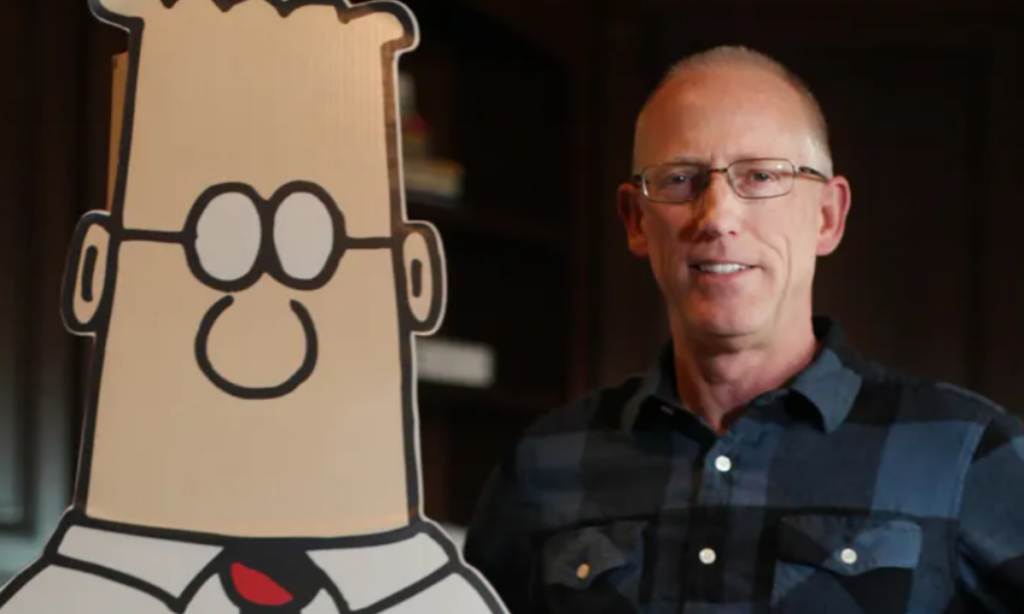
‘Dilbert’ Creator Scott Adams Dead at 68
Cartoonist Scott Adams has died after a battle with prostate cancer.
Adams’ first ex-wife, Shelly, revealed the news during a live stream on “Real Coffee with Scott Adams,” reading Scott’s final message to his fans.
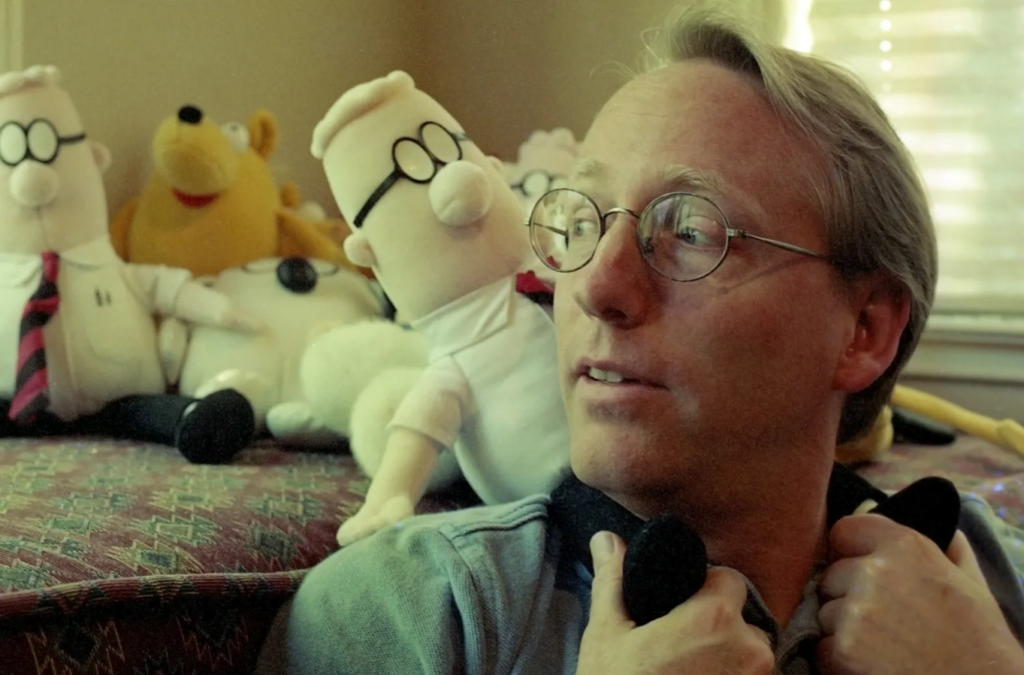
Final Days
We broke the story: Shelly told us just yesterday that Scott entered hospice earlier this month and was receiving end-of-life care amid his rapidly declining health. She said nurses were going in and out of the home while she, her daughter, and her sister were providing care as well.
Scott even recorded a podcast episode during which he acknowledged it may be his last ever, which feels even more poignant now given his passing.
Adams announced he had prostate cancer last year, which had spread to his bones and paralyzed him below the waist.
The Birth of Dilbert
In the late 1980s while working at the Pacific Bell Telephone Company Adams launched the “Dilbert” comic strip with United Media.
He became a full-time cartoonist after “Dilbert” was picked up by several hundred newspapers, and at its height, the strip appeared in 2,000 of them across the country.
Final Message
The letter dated January 1, 2026 reveals he’s still of sound mind and that he’s converting to Christianity because of the “risk-reward” calculation.
A Final Message From Scott Adams pic.twitter.com/QKX6b0MFZA
— Scott Adams (@ScottAdamsSays) January 13, 2026
Shelly couldn’t bring herself to read the whole letter during the stream, but it appears the family released it on X later in the day.
Controversy and Career Decline
Newspapers began to drop the comic strip in 2023 after Adams advised white people to “get the f*** away” from Black people in a controversial podcast episode. Scott posited his commentary on “wokeness” was why the comic strip was cut.
A Complex Legacy
Scott Adams leaves behind a complicated legacy. On one hand, he created one of the most successful and influential comic strips of the late 20th and early 21st centuries. “Dilbert” became a cultural phenomenon, perfectly capturing the absurdities of corporate culture, office politics, and workplace dynamics.
The strip resonated with millions of office workers who saw their own experiences reflected in Dilbert’s encounters with pointy-haired bosses, nonsensical management initiatives, and soul-crushing bureaucracy. Adams’ satirical take on corporate America was so effective that “Dilbert” became required reading in business schools and management training programs sometimes as cautionary tales about what not to do.
From Cubicle to Cartoonist
Adams’ own experience working at Pacific Bell gave him authentic material for his strip. He understood corporate dysfunction from the inside, which made his satire particularly sharp and recognizable. His decision to leave the corporate world and pursue cartooning full-time was itself a “Dilbert moment” escaping the absurdity he so brilliantly depicted.
At its peak, “Dilbert” was a multimedia empire, spawning books, calendars, a television series, merchandise, and making Adams a wealthy man. His book “The Dilbert Principle” became a bestseller, further cementing his status as a commentator on workplace culture.
The Controversial Turn
However, Adams’ later years were marked by increasingly controversial statements on social and political issues. His podcast and social media presence often featured provocative commentary that alienated many former fans and led to the widespread cancellation of his comic strip in 2023.
The racist remarks that led to newspapers dropping “Dilbert” represented a dramatic fall from grace for a cartoonist who had once been universally beloved. Adams’ claim that his comments on “wokeness” were the reason for the cancellation ignored the explicitly racist nature of his statements advising racial segregation.
Deathbed Conversion
His final letter’s mention of converting to Christianity based on a “risk-reward calculation” is consistent with Adams’ longtime interest in Pascal’s Wager the philosophical argument that believing in God is the rational choice because the potential reward (eternal life) outweighs the cost of belief. This intellectual approach to faith, rather than spiritual conviction, was characteristic of Adams’ analytical mindset.
Final Care
The fact that his first ex-wife Shelly was by his side during his final days, along with her daughter and sister, speaks to complex family dynamics. Despite their divorce, she remained involved enough to provide end-of-life care and to share his final message with the world.
Adams’ acknowledgment in his final podcast that it might be his last demonstrates an awareness of his deteriorating condition. The progression of his prostate cancer to his bones, resulting in paralysis below the waist, would have been extraordinarily painful and debilitating.
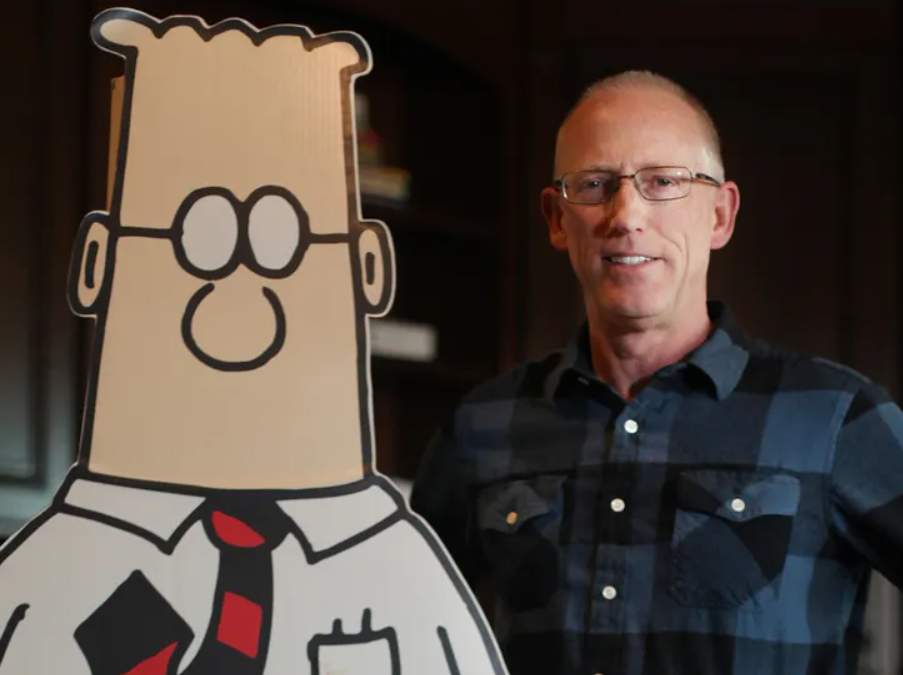
The Dilbert Legacy
Regardless of how Adams’ personal controversies tarnish his reputation, “Dilbert” itself remains a significant cultural artifact. The strip captured something essential about late 20th-century American work life in a way that will likely be studied by future historians and sociologists.
Characters like Dilbert, Dogbert, Wally, Alice, and the Pointy-Haired Boss became archetypes recognized far beyond the comic strip itself. Terms like “Dilbert” became shorthand for certain types of workplace dysfunction.
A Cautionary Tale
Adams’ life story serves as a cautionary tale about how talent and success don’t immunize someone from making destructive choices. His brilliant satirical mind, which so effectively skewered corporate absurdity, eventually turned toward increasingly toxic commentary that destroyed much of the goodwill he’d built over decades.
The contrast between the Scott Adams who created incisive workplace satire in the 1980s and 1990s and the Scott Adams who made racist statements in the 2020s is stark. Whether this represents a genuine change in his views or merely the public revelation of long-held private beliefs remains a matter of debate.
Final Thoughts
As news of Adams’ death spreads, reactions will likely be mixed. Some will mourn the loss of a talented cartoonist who brought humor to millions of office workers. Others will note that his final years were marked by self-inflicted controversy that significantly damaged his legacy.
What’s undeniable is that “Dilbert” had a profound impact on American culture and workplace discourse. The strip’s best years represented some of the sharpest corporate satire ever created, and those strips will continue to be read and appreciated long after the controversies of Adams’ final years are forgotten.
Scott Adams was 68 years old. He is survived by his family, including his ex-wife Shelly, who was with him at the end, and the millions of “Dilbert” strips that will outlive both the creator and his controversies.